All In on AI?
August 22, 2025
Observations On the Future of AI
As a Fair Observer I try to recognize that I don’t know what I don’t know. To this end, I’ve learned over time that I know more and more about less and less until finally I know everything about nothing. To be fair, this was a thought promoted by the philosopher Nicholas Butler, who believed that as one expands their knowledge, they begin to understand how much they don’t know. Often, I feel like I don’t know much, particularly when it comes to AI, but I’ve found an interesting and thoughtful source of debate around AI and other tech related subjects in the form of a podcast that I feel worthy of sharing with others who enjoy thinking about such things.
Imagine four tech billionaires, deeply integrated into the venture and start-up culture ecosystem, who came together once a week to play poker and discuss business opportunities and the evolution of the technology world. Over time they invested in each other’s funds and start-ups cementing both friendship and common business interests. But, in 2020 when the pandemic canceled poker nights, they pivoted to weekly Zoom chats. Those sessions quickly turned into a podcast called All-In, with the poker night reference, chemistry, and corresponding irreverence transforming into a popular pod cast.
I was introduced to the podcast by one of the four “Besties” billionaires behind the project, David Friedberg, known as the Mad Scientist. He was the founder of the Climate Corporation, which he sold to Monsanto for $1.1 billion. The Climate Corporation focused on offering farmers weather insurance and the climate.com service to help them track, analyze, and make field-specific decisions on their farms to improve farming outcomes. Those of you who know me understand that I have a deep interest in regenerative and organic farming via my work with iSelect Funds, our venture capital affiliate in St. Louis, and their focus on Ag-tech, and food is health. This led me to the All-In podcast where I discovered his other co-hosts and their weekly dialogue.
Chamath Palihapitiya known on the podcast as The Disrupter, is an electrical engineer from Canada. He was an early employee at AOL and then tapped by Facebook to lead the growth and mobile teams. He is the Founder of Social Capital, investing in transformative ventures across healthcare, AI, climate, and space. He is also known as the SPAC King, for his pioneering use of SPAC parachutes to bring to market portfolio companies like Virgin Galactic and SoFi. I find him very interesting because he deeply understands tech at the technology level, often takes a contrarian viewpoint, and is good at unpacking things like AI from an investment level using the math of finance – which helps my understanding of these technologies.
Perhaps the most well know Bestie on the podcast is David Sacks. Known as the Rainman, Sacks is currently the White House “AI & Crypto Czar” and Chair of the President’s Council of Advisors on Science and Technology under the Trump administration. Posts which elevated him beyond Silicon Valley circles into the world of politics and policy where he is strong on meaningful insights. With a law degree from the University of Chicago, he is good at unpacking the intersection of policy and the legal implications of proposed legislation. He was an early PayPal product leader and COO; and founded Yammer, which was acquired by Microsoft for $1.2 billion. He is a co-founder of Craft Ventures which has interests in Airbnb, SpaceX, Slack, and Star Link. Like his good friend Elon Musk, Sacks was born in South Africa and emigrated to the US for college.
Finally, Jason Calacanis, who acts as the podcast moderator and has been a longtime podcaster with popular shows, This Week In Startups and Open Angel Forum. He co-founded Weblogs, Inc. (early blog network) and later sold it to AOL. He is the New York guy on the show, born in Brooklyn and educated at Fordham in psychology, he tries to bring the Gotham type edginess to the show but is a bit too nice to bring it off easily. In 2006, Calacanis joined Sequoia Capital, as an EIA (entrepreneur in action) a position which he held until May 2007. Through this program, Calacanis invested $25K in Travis Kalanick's company, Uber. As of Friday (8/22/2025) the investment was worth roughly $900 million.
Why all this background on these four tech-bro billionaires? Because, if you listen to the dialogue carefully, the All-In podcast often yields some real gems of insight, and some debates on things like AI and technology, that yield some counternarratives that I assure you will never be surfaced on mainstream sources or in Wall Street research.
A great example of this type of discussion is the recent banter about the real value of the massive AI infrastructure spend among and between the mega-cap leaders in the space. I’d recommend watching it on YouTube, because they often reference charts and graphs in the discussion. It can be found here: https://www.youtube.com/@allin. It’s the 8/22/2025 episode #240, and the discussion starts about nine minutes into the podcast and runs about 21 minutes; Listen to that and then ponder this:
AI Mania hits the brakes: sign of a bubble or a healthy correction?
We all put the last week of our investment lives on hold while waiting for Federal Reserve Chair Jerome Powell’s divine words at Jackson Hole. The signal that a September interest rate cut could be on the table has eased worries about seemingly stretched tech valuations and shifted investor focus to Nvidia earnings, the next major test for the stock market’s AI-fueled rally.
Last week tech stocks languished as traders debated whether valuations had reached unsustainable levels given the current economic and earnings environment. With the S&P 500, now trading at 24 times projected 12-month earnings, that’s roughly 30% more than the equal-weight version of the index.
Not only is such a high valuation premium extremely rare, it’s occurred just 0.8% of the time in data going back to 2010, according to Bloomberg Research, but it has also been a harbinger of poor future performance in the past. When the valuation ratio between the S&P 500 and its equal-weight peer crossed 1.3 last July, the S&P 500 proceeded to drop 8.5% over the next three weeks. When it happened again in December, the market fell once again.
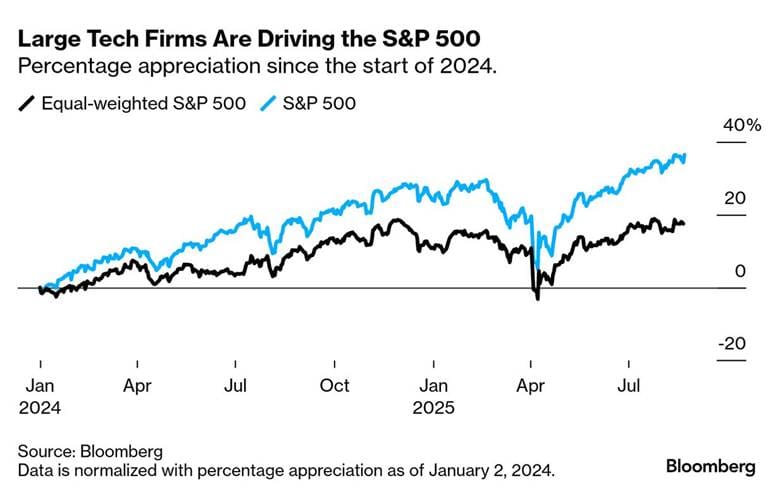
Powell’s dovish Jackson Hole comments seem to have spread a wave of calm across Wall Street. Now, all eyes have turned to the Aug. 27 earnings report from the poster child of the AI revolution: Nvidia, whose stock has nearly doubled since early April to trade around all-time highs on optimism tied to the AI boom.
The stakes for markets are high. Nvidia holds a weight of about 7.9% of the S&P 500, higher than any other stock. Options traders are pricing in a move of more than 6% in either direction following its report on Wednesday evening. In turn, traders are pricing in a move of about 0.8% for the S&P 500 on Aug. 28, according to Piper Sandler data as of Aug. 21. That’s slightly bigger than the predicted 0.75% move on Sept. 5 following US payroll data, and the 0.72% swing following inflation data on Sept. 11.
A Fair Observer might argue that few events matter as much for markets as the words of the Fed chair about the FOMC policy framework, but with tech giants dominating the S&P 500 and AI the dominant among investors, an update from Nvidia is certainly an event that for market watchers should not be ignored.
Rick Imperiale
Writing as The Fair Observer